Before a hiring rule removes someone,
show who it removes.

What I did

Product design + front-end build

Built with

React, Next.js, TypeScript

Quick link

Interactive prototype

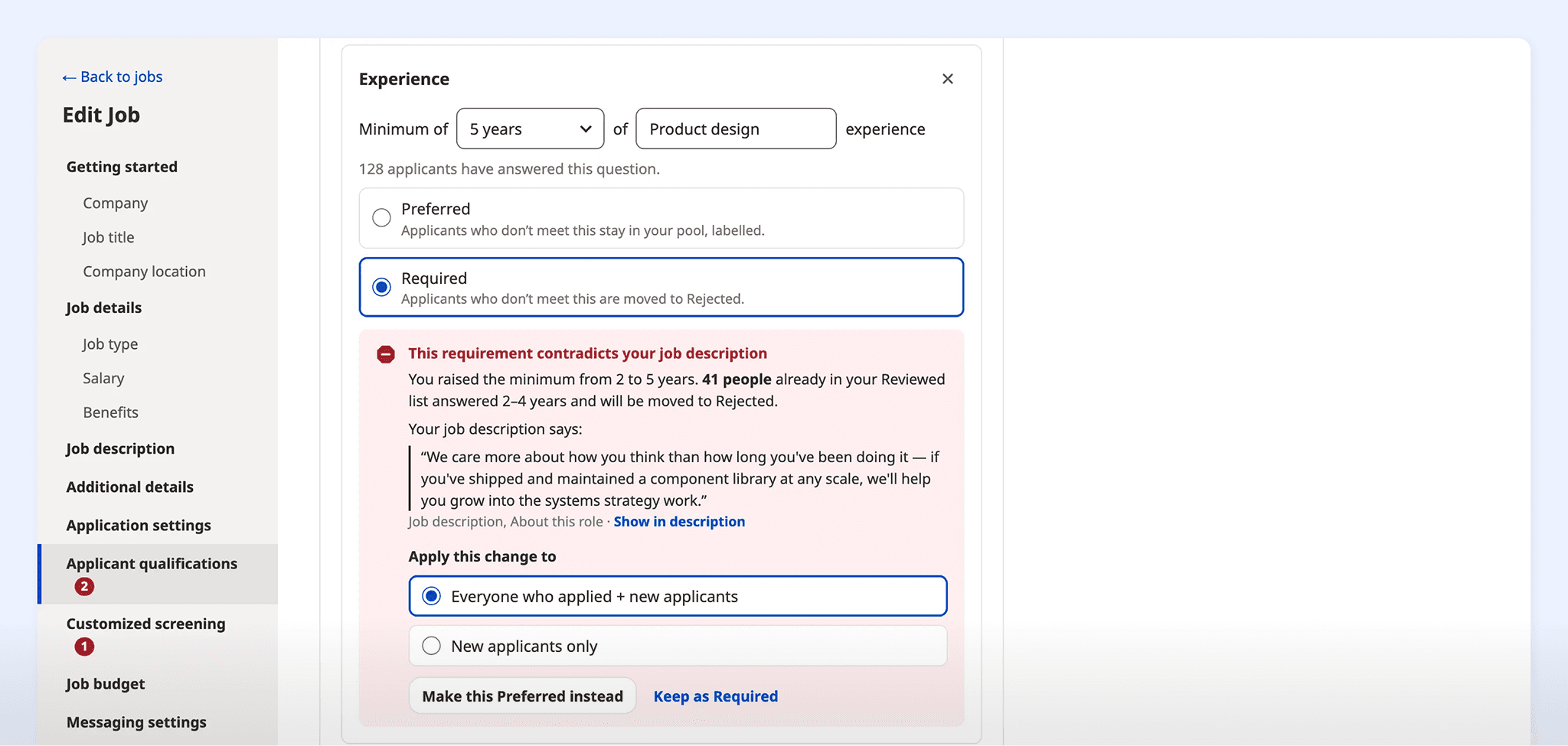
Indeed's Edit Job page. The Experience qualification has been raised to 5 years and marked Required. Beneath it, a red callout reads: This requirement contradicts your job description. 41 people already in your Reviewed list answered 2–4 years and will be moved to Rejected. The job description's own sentence is quoted underneath, with the options Make this Preferred instead and Keep as Required.
Independent concept, built in four hours in Indeed’s employer design language, directing AI agents for research, implementation and adversarial review; the decisions are mine. Not affiliated with Indeed. The employer, applicants and every number shown are fictional.

How did it start?

I found Indeed through the UX Designer role. It asks for someone who can make complex flows legible on both sides of the marketplace.

So I went looking for one moment where the employer and the job seeker are looking at the same decision from opposite sides.

The problem

When a recruiter tightens a Required qualification on a live job, they can’t see who it removes —
or that their own job post still promises the opposite.

The job description candidates read and the qualifications that filter them are separate fields in the same Edit Job form. Editing one does nothing to the other.

Indeed is explicit about what a Required rule does: “Applicants who don’t meet a required screener question are automatically moved to your Rejected list.”

Created together · edited apart

How a job post and its screening rule come apartA job description and its applicant qualifications are created together. Later only the qualification is edited, raising a Required threshold. The description does not change with it. Applicants below the new bar are moved to Rejected while the description still promises the opposite, and nothing shows the recruiter the gap.Job descriptionWhat candidates readApplicant qualificationsWhat actually filtersLeft as published“we hire for trajectory”Edited laterRequired raised 2 → 5 yearsno link between them41 applicantsmoved to RejectedPost still promisesthe oppositeFound laterif at all

Nothing in the flow shows the recruiter that the two no longer agree.

Who this is for

Two people on opposite sides of the same sentence, and only one can see the rule.

Primary

In-house recruiter, 50-to-500-person company

Hiring one specialised role, with more applicants than screening time.

SeesJob postQualificationsWho a rule removes

Approved working persona, not interviewed. Volume evidence is from 500+-employee firms, a different segment.

Secondary

The job seeker reading that post

Deciding whether to apply on a promise they expect to be honoured.

SeesJob postQualificationsWho a rule removes

Grounded in dated 2026 reports of mismatched filtering and Indeed’s own Required-answer guidance.

The hypothesis

If Indeed checks Required qualifications against the live post while a recruiter edits them, more harmful mismatches get resolved before applicants are affected —
without relaxing legitimate must-haves just to clear a warning.

The second half is the guardrail. A screen that goes green because every Required became Preferred has made screening worse.

And the edit moment, not a review dashboard, because a review pile finds the problem after the rule has acted.

What Match Check does

A fictional role, live for 21 days, 128 answers to its Experience question. The recruiter raises the minimum from two years to five.

Match Check answers in place: 41 people you already reviewed will move to Rejected, and here is your own sentence that says otherwise.

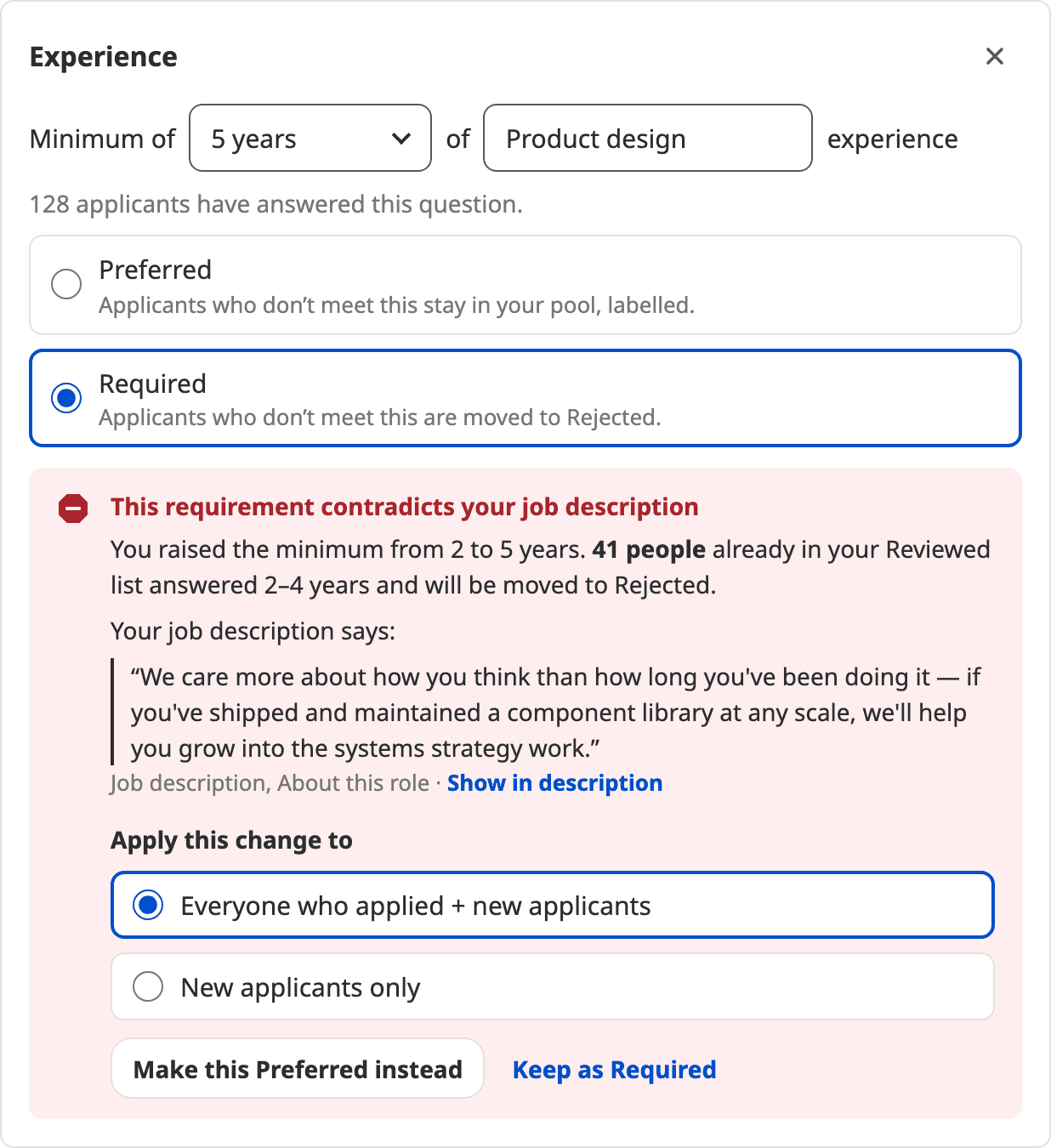
The Experience qualification card at 5 years, Required. A red callout reads: This requirement contradicts your job description. You raised the minimum from 2 to 5 years. 41 people already in your Reviewed list answered 2–4 years and will be moved to Rejected. The post's sentence is quoted, followed by Apply this change to: Everyone who applied + new applicants, or New applicants only.
The count is derived from the fixture's per-year distribution, never typed in. It does not claim the 41 were qualified — only that a rule removed them and the post said something else.

It says which kind of difference it found

Flag every difference and it becomes a banner people learn to ignore. So it names three cases, in words rather than colour.

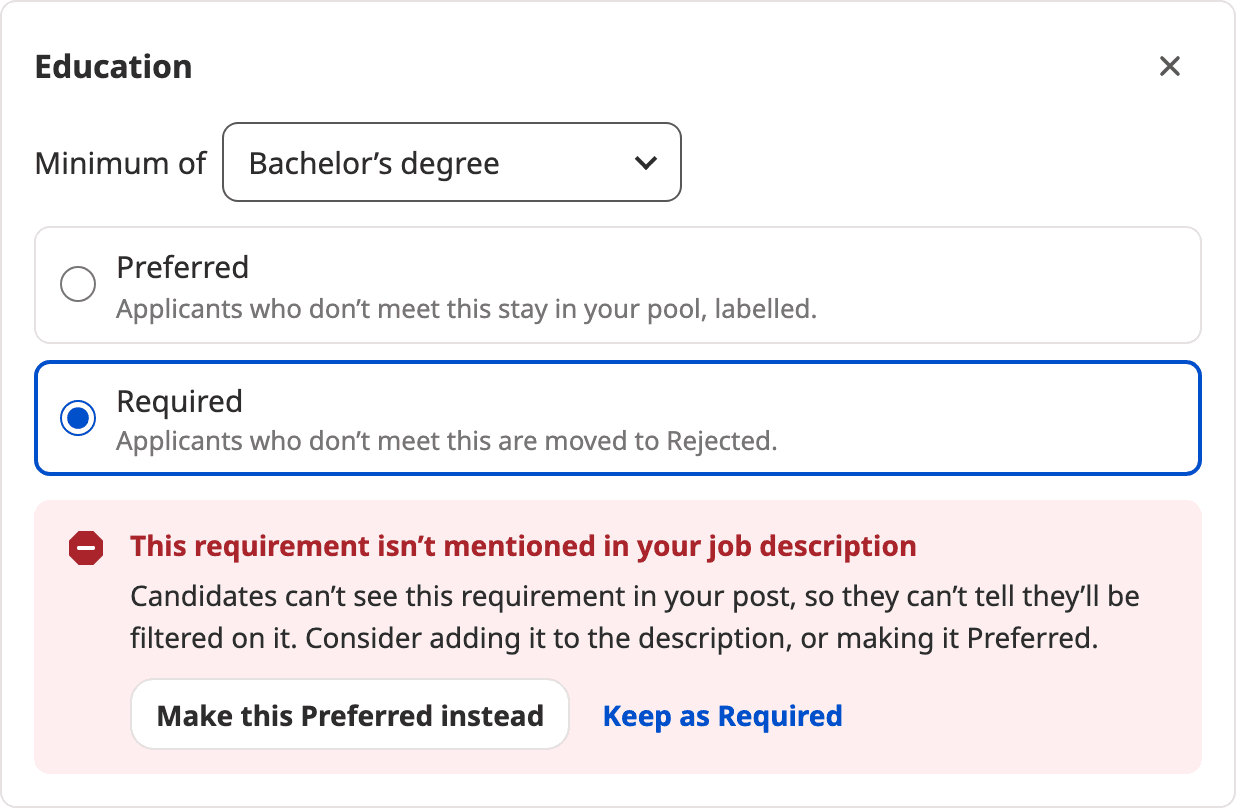
The Education qualification card, Bachelor's degree, Required. A callout reads: This requirement isn't mentioned in your job description. Candidates can't see this requirement in your post, so they can't tell they'll be filtered on it.
Not mentioned. Candidates are filtered on something the post never told them. (Contradicts is the state shown above.)
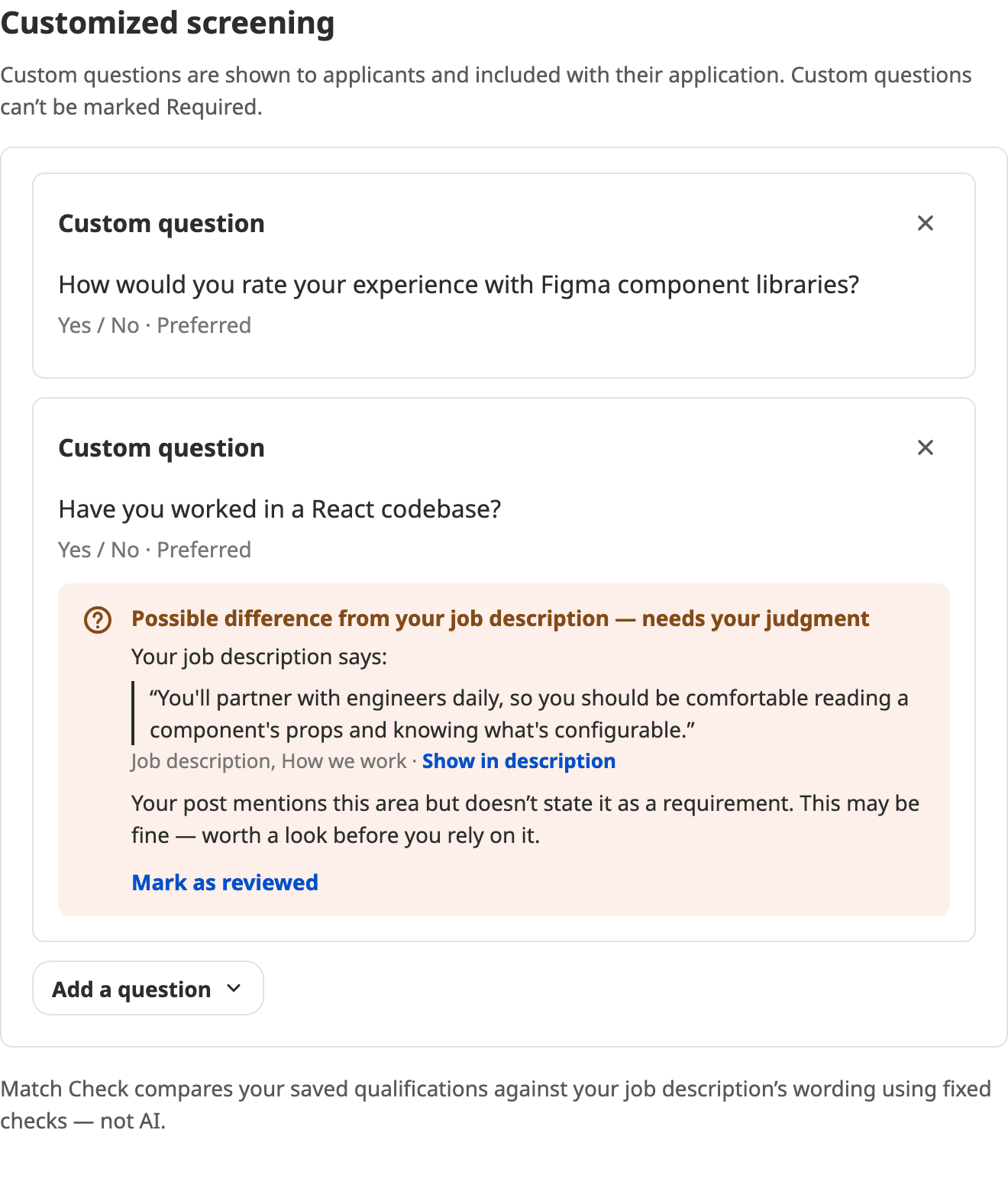
A custom screening question, Have you worked in a React codebase, with an amber callout: Possible difference from your job description — needs your judgment. The post's sentence about partnering with engineers is quoted, and the only action is Mark as reviewed.
Ambiguous. The post gestures at it without requiring it, so the only action offered is a person's judgement.

Resolving it never produces a green light

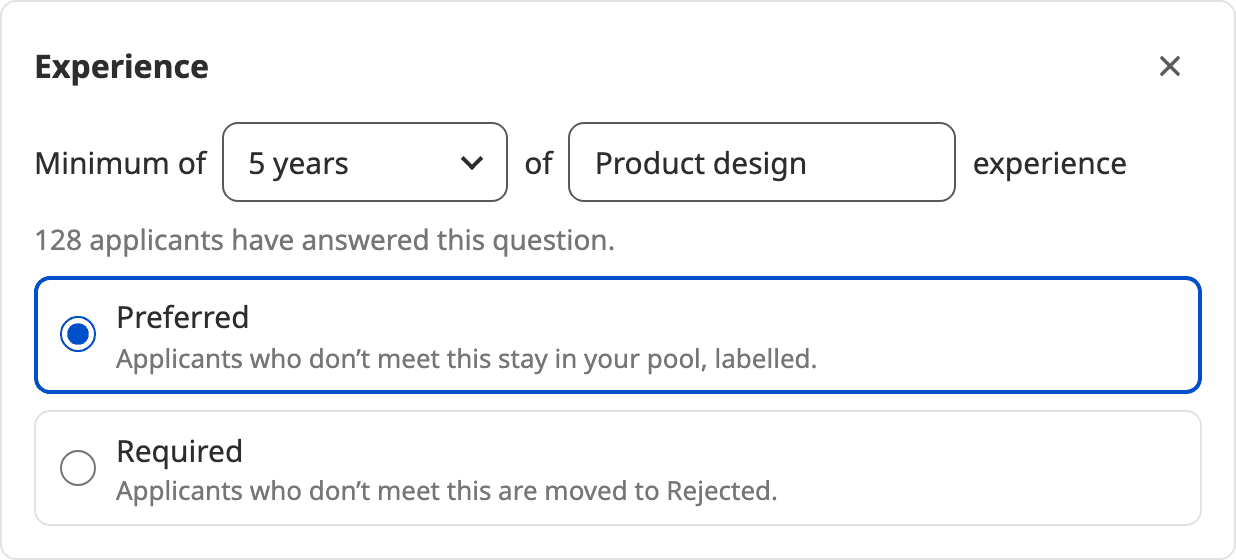
The primary action is small: Make this Preferred instead keeps the signal and keeps the person. The recruiter can also limit the bar to new applicants, or keep it Required and say why.

Keeping it never clears the flag.

The Experience card after choosing Make this Preferred instead: 5 years is still set, Preferred is selected, and the callout is gone.
Preferred keeps the five-year signal and keeps the 41 people in the pool, labelled.
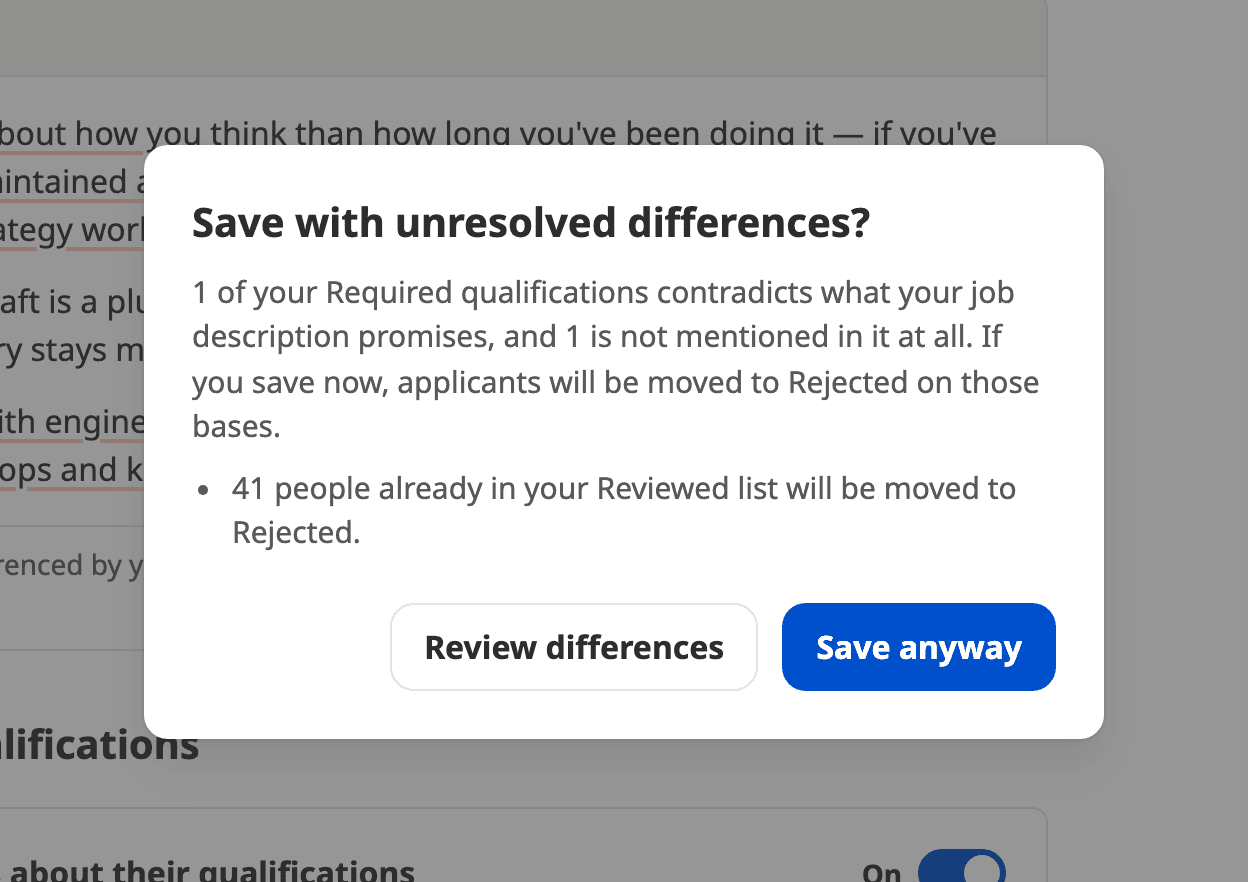
A dialog: Save with unresolved differences? 1 of your Required qualifications contradicts what your job description promises, and 1 is not mentioned in it at all. If you save now, applicants will be moved to Rejected on those bases. 41 people already in your Reviewed list will be moved to Rejected. Buttons: Review differences, Save anyway.
Saving with open Required mismatches states the consequence and offers a way back.
An amber status at the top of the page: Saved. 2 required qualifications still auto-reject applicants — 41 already-applied people moved to Rejected.
Saved anyway. The status says what is still true; it does not congratulate.

And when it has nothing to say, it says only that

Fixed rules over structured qualifications and pre-tagged sentences — not AI, not a fairness audit, and the interface says so.

Its empty state is scoped to what it actually checked.

The Save footer reading: No differences found in the qualifications checked.
No green tick, no “all clear”. Just the boundary of what was checked.

Prototype in React

Raise the Experience requirement and watch the count change; switch it to Preferred and watch the warning resolve honestly.

Live prototype. Raise the requirement, watch who it removes, resolve it. Open full screen ↗

The first pass looked branded, not native

My first build put verified Indeed tokens on an invented page structure. I threw it away, rebuilt from public references to the real Edit Job screens, and checked it element by element against live computed styles.

Inside the prototype, Indeed Sans and the product wordmark aren’t licensed to reproduce, so it ships Noto Sans and a typeset wordmark: token-matched, not pixel-identical.

What I would test first

Adversarially reviewed, not yet tested with recruiters. Five recruiters, one task, watching for comprehension rather than preference:

“This job has been live for 21 days. The hiring manager asks you to raise the experience requirement from two to five years. Make that change as you normally would, and save it.”

  • Do they notice the mismatch unprompted?
  • Do they understand what happens to existing applicants versus new ones?
  • Do they keep a real must-have Required rather than relaxing it to clear the warning?

If it shipped: fewer applicants excluded by requirements the post contradicts, fewer restores from Rejected, fewer criteria edits after the first batch arrives.

Evidence and limits

  • Public documentation shows no surface that reconciles a post with its rules at the edit moment. That is an observation about documentation, not a claim that Indeed lacks one. The falsifier: if the authenticated Edit Job flow already does this, the concept is redundant.
  • Indeed documents what Required and Preferred do to an applicant, not whether editing a qualification leaves the description untouched. I treat them as the separate fields they appear to be.
  • The recruiter is a working persona. How often this mismatch happens is unknown.
  • A reconciliation aid, not a fairness or job-relatedness audit. All data fictional.

SourcesThe role · Indeed on screener questions · Indeed on screening criteria. Verified 30 August to 2 September 2026.